The Siren Song of the Crowd: How Herd Behavior Hijacks Your Investment Strategy
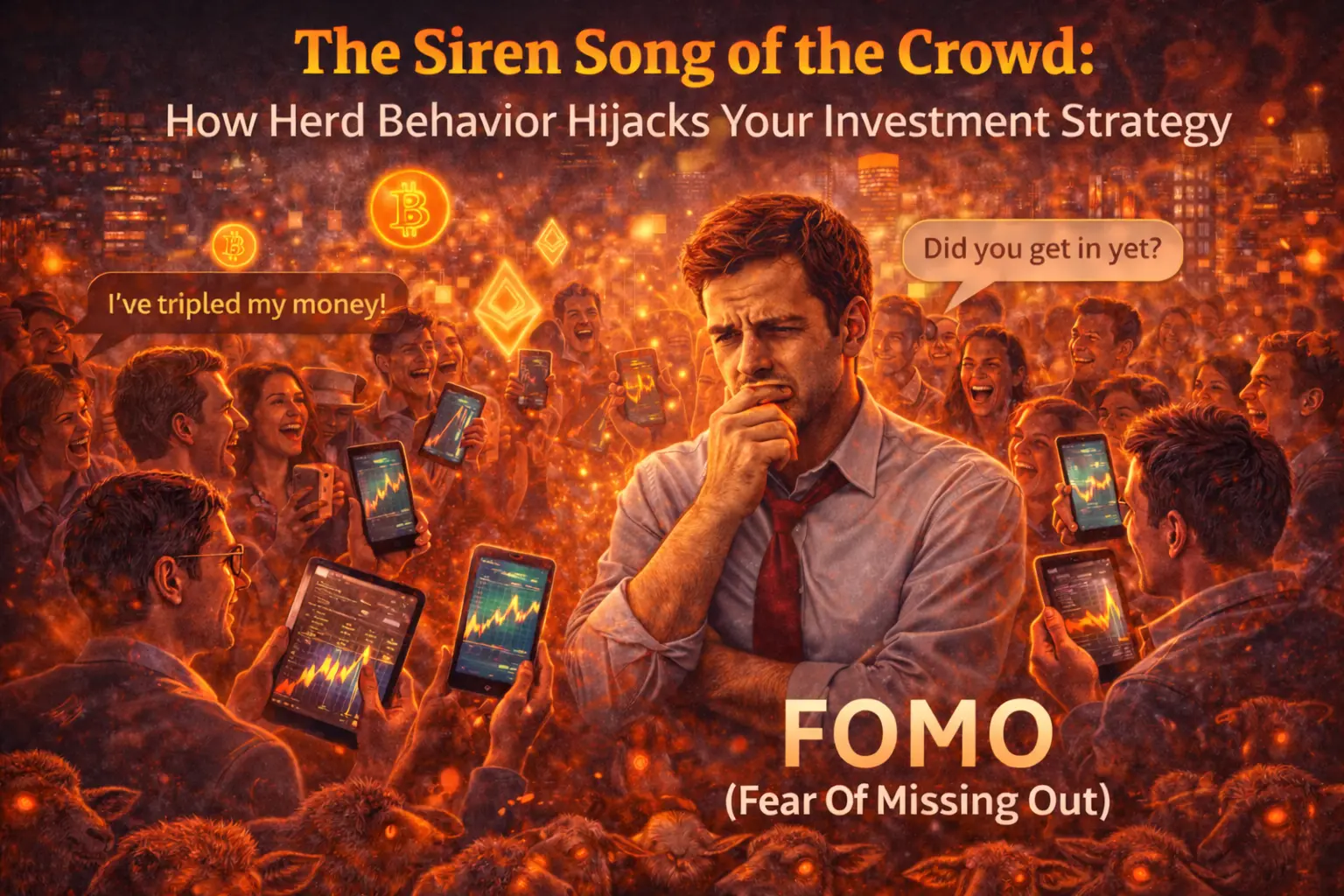
You’re at a party. Everyone is buzzing about a new “AI-driven” stock or a crypto project that’s surged 50% in a week. Your neighbor—who usually struggles to balance their checkbook—tells you they’ve “tripled their money” and asks if you’ve “gotten in” yet.
You feel a sharp, uncomfortable twitch. It’s not just curiosity—it’s FOMO (Fear Of Missing Out). You think: If they are making this much, why am I the only one on the sidelines? Before you know it, you’ve hit the “Buy” button at the absolute market peak. You have just become part of the Herd.
1. What is Herd Behavior?
In behavioral finance, Herd Behavior is the tendency for investors to follow the actions—or even the emotions—of a larger group—rather than relying on their own independent analysis.
It is a deep-seated evolutionary trait. On the savannah, if your tribe started running, you didn’t stop to ask, “Is there really a lion, or is this just a false alarm?” You ran. Those who stopped to analyze were eaten.
In the stock market, however, this survival instinct is a disaster. When everyone runs in the same direction, they create a bubble; when they stampede in reverse, they trigger a crash.
2. Why We Follow the Crowd: The “Trifecta of Irrationality”
You aren’t just battling one bias; you’re battling a team of saboteurs. Herd Behavior is the “engine,” but these biases are the steering wheels:
- Social Proof: We subconsciously believe that if thousands of people are buying a stock, they must have information we don’t.
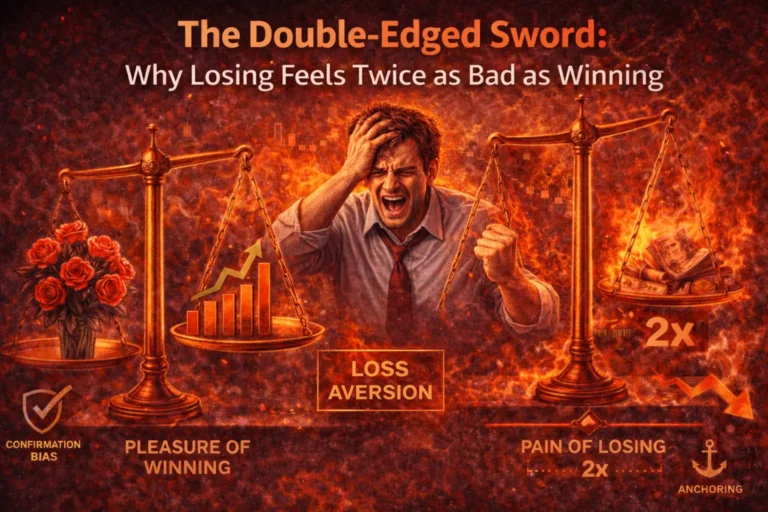
- Loss Aversion: We follow the crowd to avoid the “pain” of being the only one missing out on a profit.
- Confirmation Bias: We seek out news that justifies why the “herd” is right, ignoring red flags.
The Money Mandal Reality Check: Being a contrarian is lonely. But in the stock market, being lonely is often the only way to stay profitable.
3. The Three Acts of a Market Bubble
Herd Behavior follows a predictable, three-act play that every investor must recognize:
- Act I: The Accumulation. A few smart investors buy an undervalued asset. The herd is skeptical.
- Act II: The Mania. Prices rise. The media picks up the story. “Social Proof” kicks in. The herd stampedes in, buying simply because the price is going up.
- Act III: The Blowoff Top. Even the most conservative investors join, driven by pure FOMO. When there is no one left to buy, the herd realizes the price is disconnected from reality. Panic sets in, and the stampede reverses.
4. How to Build Your Independent Toolkit
How do you stop your brain from wanting to “join the tribe”? You need a system that values data over social validation.
- The “Zero-Tribalism” Rule: If your primary reason for buying a stock is because you saw it on a “Top 10” list or a social media trend, do not buy it. If you can’t explain the thesis in three sentences without mentioning an influencer, you don’t know the investment.
- The Money Mandal Mandly Audit: Before entering any “hot” trade, write in your MandLy: “Am I buying this for the fundamentals, or because I feel I’m missing out?” Writing forces your brain to switch from “Herd Mode” (emotional) back to “Independent Mode” (logical).
- The Contrarian Checklist: Every time you see a stock skyrocketing, force yourself to spend 30 minutes searching for the negative case. Find the critics. Read the skeptics. If their arguments don’t make you nervous, you haven’t looked hard enough.
5. Summary: The Herd vs. The Pro
To help you stay objective, keep this comparison in mind:
| The Herd (Sheep) | The Pro (Shepherd) |
| Buys because “the price is rising.” | Buys because “the business is undervalued.” |
| Follows influencers and news headlines. | Follows a strict, pre-defined plan. |
| Panic-sells when the crowd turns. | Sees corrections as buying opportunities. |
| Views volatility as a reason to run. | Views volatility as a market feature. |
6. The “Independent” Reality Check
Ask these 4 questions before you join the stampede:
- The “Reason” Test: Can I explain why this investment is actually undervalued, or am I just looking at a pretty chart?
- The “Crowd” Check: Is this asset being talked about on mainstream news and social media? (If yes, you are likely late).
- The Loneliness Test: Would I feel comfortable holding this if I had to tell my friends I’m the only one who owns it?
- The Thesis Test: Has the fundamental business improved by 50% just because the price did?
Conclusion: Be a Shepherd, Not a Sheep
The herd is powerful, but it is blind. It doesn’t care about your retirement, your risk tolerance, or your financial freedom. It only cares about the next movement.
To succeed, you must learn to stand apart. When the crowd is screaming in greed, you should be calmly evaluating your exit. When the crowd is screaming in fear, you should be calmly evaluating the value.
Master your independence, ignore the noise, and let the herd stampede without you.
Why is it so hard to stay on the sidelines when everyone else is making money?
This is driven by Social Proof, a biological survival mechanism. Our ancestors learned that if the “tribe” was moving in one direction, staying behind usually meant danger. In the stock market, your brain interprets others’ profits as your “loss,” triggering an intense FOMO (Fear Of Missing Out). This makes “doing nothing” feel physically uncomfortable, even when your logic tells you the market is overpriced.
Is “Herd Behavior” the same as following a trend?
Not quite. Trend following is a disciplined strategy based on technical data and momentum. Herd Behavior is an emotional reaction based on social pressure. The difference is the “Why”:
A Trend Follower buys because the data shows a high-probability setup.
A Herd Member buys because they saw a “trending” post on social media and feel like they are being left behind.
How do I know if I’m late to a market “stampede”?
A classic sign that you are in Act III (The Blowoff Top) is when people who have no interest in finance—like a neighbor or a taxi driver—start giving you “hot” investment tips. When an asset is being talked about everywhere from mainstream news to your social media feed, the “Social Proof” is at its peak. This usually means the smart money (The Shepherds) has already bought in, and the herd is simply pushing the price to an unsustainable level.
How does the Money Mandal MandLy help me stay independent?
The MandLy acts as a “Tribalism Filter.” By forcing you to write down your specific investment thesis before you buy, it moves your decision-making from the emotional brain to the logical Prefrontal Cortex. If you find that you can’t explain why you’re buying a stock without mentioning a “trending” hashtag or an influencer’s name, the MandLy exposes that you are following the herd, giving you the chance to step back before it’s too late.