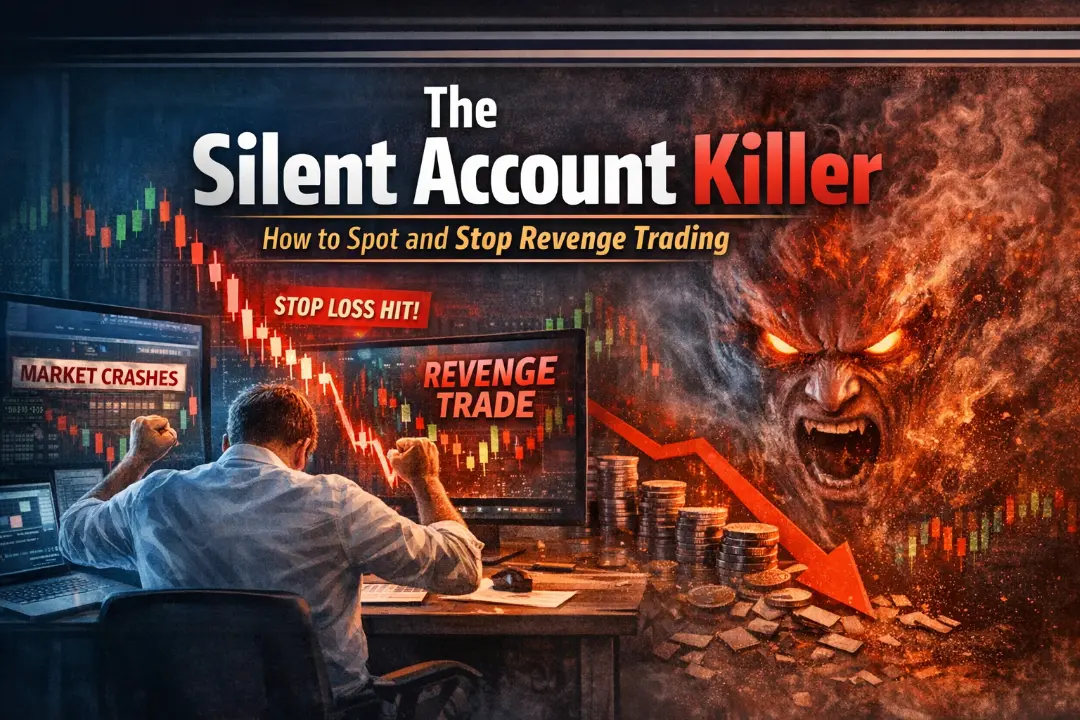
The Silent Account Killer: How to Spot and Stop Revenge Trading
We’ve all been there.
You’ve spent all morning analyzing the charts. You find a setup that looks “perfect”—the moving averages cross, the RSI is oversold, and the price is bouncing off a major support level. You enter the trade with calculated confidence, only for a sudden, unexpected news spike to hit your stop-loss. You’re out. You’re frustrated. And most importantly, you’re angry.
Instead of stepping away, your brain goes into overdrive. “The market is wrong,” you think. “The big banks just hunted my stop. I need to win that money back right now.” You double your position size, ignore your strategy, and jump back in.
Two hours later, your account is down 10%, and the “perfect” setup has turned into a financial disaster.
Welcome to Revenge Trading—the single most common reason retail traders blow their accounts. At Money Mandal, we believe that while your strategy makes you a trader, your psychology determines if you stay one. To master the market, you must first master the “Inner Market” of your mind.
1. What Exactly is Revenge Trading?
Revenge trading is the act of entering a trade out of anger, frustration, or a desperate need to “make back” a recent loss. It is a purely emotional response where the goal is no longer to follow a high-probability setup, but to settle a score with the market.
In the world of behavioral finance, this is a specialized and aggressive form of Loss Aversion. Because the pain of losing is so intense—researched by pioneers like Daniel Kahneman to be twice as powerful as the joy of winning—our brain switches from “Calculating Mode” to “Fight-or-Flight Mode.” We view the market as an enemy that has “stolen” from us, and we try to take it back by force.
It is a paradox of trading: the more you need to win back your money, the more likely you are to lose it.
2. The Anatomy of a Revenge Trade: The Brain in Crisis
To stop the cycle, you have to understand the biological “mismatch” happening in your head. Our brains are evolved for survival on the savannah, not for managing a digital portfolio.
The Amygdala Hijack
When you take a loss—especially a “stingy” one where you were “almost right”—your Amygdala (the emotional center of the brain) sends out a distress signal. It perceives the financial loss as a physical threat to your status and safety. This triggers a flood of cortisol and adrenaline.
The Logical Shutdown
While the Amygdala is screaming for action, your Prefrontal Cortex—the part of the brain responsible for logic, risk management, and long-term planning—essentially goes offline. In this state, you aren’t trading a strategy anymore; you are reacting to a perceived threat. This leads to three classic, account-ending mistakes:
- Increased Position Sizing: Trying to win it all back in one “hero” trade.
- Forced Entries: Seeing “patterns” in random noise just to get back into the game.
- The “Hope” Strategy: Moving your stop-loss further away because you “know” it will turn around this time.
3. The Psychological Triggers of the Revenge Trap
Revenge trading doesn’t happen in a vacuum. It is usually triggered by specific psychological “wounds”:
The Wound of the “Perfect Trade”
The more time you spend analyzing a trade, the more “certain” you feel. When a “perfect” trade fails, it feels like a personal betrayal by the market. This shatters the ego, and the ego demands a comeback.
The “Break-Even” Obsession
Many traders have a mental target for the day. If they are down ₹5,000, they feel they cannot close their laptop until they are at ₹0. This “Mental Accounting” bias makes you ignore the fact that the market doesn’t care about your daily P&L. It will not provide a setup just because you have a goal.
The Gambler’s Fallacy
After a string of losses, the human brain mistakenly believes that a win is “due.” You tell yourself, “I’ve lost three times today; the next one has to be a winner.” In reality, every trade is an independent event with its own probability. The market has no memory of your previous losses.
4. The “Revenge Trap” Cycle: A Descent into Ruin
Revenge trading follows a predictable, destructive path that Money Mandal helps you break:
- Stage 1: The Standard Loss. A normal, calculated part of the business.
- Stage 2: The Emotional Spark. You feel “cheated” by a wick or a sudden news event.
- Stage 3: The Impulse. Without checking your rules, you enter a trade 2x larger than the previous one.
- Stage 4: The Escalation. The market moves against you again. Now, the loss is significant. You refuse to cut it because the pain of realizing it is too high.
- Stage 5: The Blowout. The “hero trade” fails. You have lost weeks’ worth of profits in minutes.
- Stage 6: The Post-Trade Guilt. You feel ashamed, leading to a “frozen” state where you miss the next actual high-probability setup because your confidence is shattered.
5. Why Traditional “Discipline” is Not Enough
Standard trading books tell you: “Just be disciplined.” Or, “Don’t trade with emotion.” This is like telling someone who is drowning to “just breathe.” It’s technically correct, but practically impossible when you’re in the middle of an emotional storm. At Money Mandal, we know that discipline isn’t a personality trait you’re born with—it’s a system you build.
Professional traders aren’t people who don’t feel anger, they are people who have systemic circuit breakers that prevent that anger from touching the “Order” button.
6. How to Build a “Psychological Fortress”
If you want to stop revenge trading forever, you need to implement a “Defense in Depth” strategy.
Strategy 1: The “Daily Loss Limit” (The Hard Stop)
Before you open your first trade, decide exactly how much you are willing to lose in a single day. This should be a number that doesn’t ruin your sleep. If you hit that number (e.g., 1.5% of your capital), you are done. * Action: Uninstall the trading app from your phone for the day. Change your password if you have to. Physical distance is the only cure for a hijacked amygdala.
Strategy 2: The “Mandatory Cool-Down”
After any loss, your brain needs at least 30 to 60 minutes for the cortisol to clear your system.
- Action: Implement a rule: “After a loss, I cannot place another trade for 1 hour.” Use this time to leave your desk. Physical movement—like a walk or even just 20 pushups—helps reset your nervous system and brings your logic back online.
Strategy 3: Using the Money Mandal MandLy
The MandLy is your most powerful weapon against the “Revenge Monster.” Most journals only track price and time. MandLy tracks you. Before you enter a “recovery” trade, you must answer these in your journal:
- “Am I entering this because I see a setup, or because I’m mad about the last loss?”
- “If I hadn’t lost money 10 minutes ago, would I still think this is a good trade?”
- “What is the risk? Is it larger than my standard risk?”
Writing forces you to use the Prefrontal Cortex. You cannot write a logical sentence while being purely emotional. The act of journaling is the “Nudge” (as Richard Thaler would call it) that pushes you back toward rationality.
7. The Philosophy of “Trading as a Business”
In any other business, if a machine breaks, you turn it off and fix it. You don’t start throwing tools at it in a rage.
Trading is the same. A loss is just a “cost of goods sold.” It is an expense, not a personal insult. When you stop taking the market personally, you take away its power to trigger your “revenge” instincts. The market is just a giant machine that matches buyers and sellers; it doesn’t know you exist, and it certainly doesn’t “owe” you anything.
8. Identifying Your Revenge “Archetype”
Not all revenge traders look the same. Which one are you?
- The Doubler: You believe you can “average down” out of any mistake. (Outcome: Massive drawdowns).
- The Scalper-Turned-Gambler: You lost on a 5-minute chart, so you move to a 1-minute chart to find “quick wins.” (Outcome: Death by a thousand cuts/commissions).
- The News Chaser: You feel the market “lied” to you, so you jump into the most volatile pair to “punish” the market. (Outcome: Slippage and total loss).
Recognizing your archetype allows you to set specific rules to counter it.
9. Conclusion: Mastering the Silence
The best traders aren’t the ones with the most complex indicators; they are the ones who can walk away after a loss with their ego intact. They understand that capital preservation is more important than being right.
Revenge trading is a battle against the market that you will lose 100% of the time. The real battle is the one happening inside your mind. By building a system that accounts for your humanity—using tools like Money Mandal’s MandLy and strict loss limits—you transform from a “market participant” into a “market professional.”
Don’t let one bad trade turn into a bad week. Master your psychology, protect your capital, and live to trade another day.
The “Anti-Revenge” Pre-Trade Checklist
Ask these 5 questions before your next entry:
- Pulse Check: Is my heart racing? Is my jaw clenched? (If yes, you are in “Fight” mode—DO NOT TRADE).
- The “Independent Event” Test: If this was my very first trade of the month, would I still take it?
- Risk Audit: Am I using my standard risk, or have I increased it to “catch up”?
- Strategy Match: Can I point to the specific rule in my plan that this trade satisfies?
- The “Done” Rule: If this trade hits its stop-loss, am I prepared to walk away for the day?
Why do I feel an actual physical urge to trade again right after a loss?
This isn’t just “weakness”; it’s biology. When you take a loss, your brain’s Amygdala (the emotional alarm system) triggers a “fight-or-flight” response. It perceives the lost money as a threat to your survival, flooding your body with cortisol and adrenaline. This “hijacks” your logical brain, making impulsive, aggressive trading feel like a necessary survival tactic rather than a financial mistake.
Is “averaging down” on a losing position considered revenge trading?
If you are adding to a loser because your original data-driven strategy called for a “scaled entry,” then no. However, if you are doubling your position size simply because you are angry at the market and want to “break even” faster, you have fallen into the Revenge Trap. This is often driven by the Gambler’s Fallacy—the false belief that because the market went against you, it “owes” you a reversal.
How long should a “Mandatory Cool-Down” actually last?
Science suggests it takes roughly 30 to 60 minutes for stress hormones like cortisol to clear your system after a high-stress event. At Money Mandal, we recommend a full hour. During this time, you must physically leave your trading desk. Movement—like a walk or quick exercise—helps reset your nervous system and brings your Prefrontal Cortex (the logic center) back online.
How does writing in a journal stop an emotional impulse?
You cannot easily be highly emotional and highly analytical at the same time. The act of using the Money Mandal’s MandLy forces you to translate “feelings” into “words.” This transition shifts brain activity from the emotional Amygdala to the logical Prefrontal Cortex. By the time you finish answering the Pre-Trade Checklist, the emotional “fog” has usually cleared, allowing you to see the trade for what it really is.