The Prisoner’s Dilemma of the Portfolio: Why We Cling to Losing Stocks
We’ve all been there.
You bought a stock with the best of intentions—the fundamentals looked solid, the trend was in your favor, and you had a clear thesis. But then, the tide turned. The share price began a steady, grinding decline.
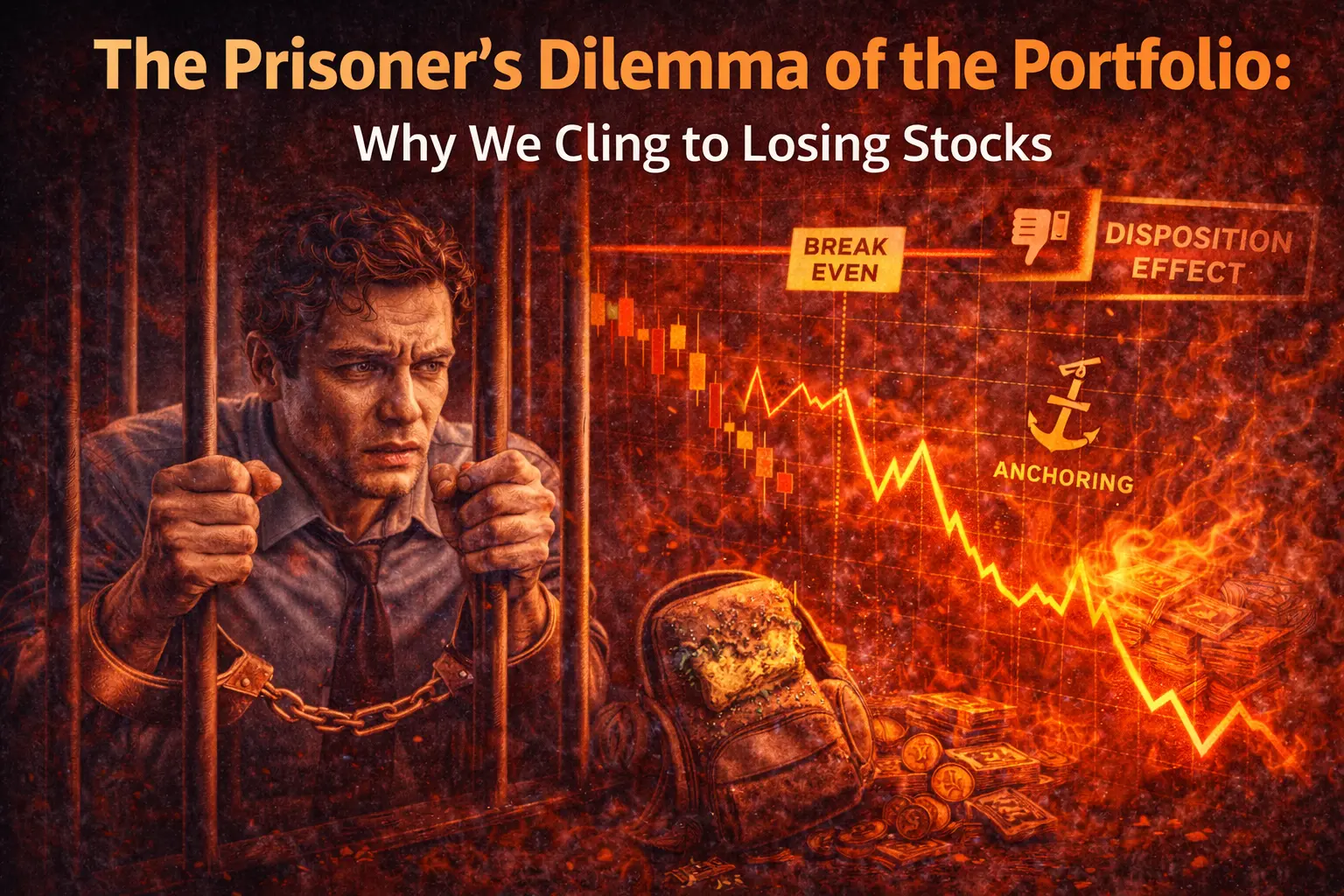
At first, you told yourself it was just “market noise.” Then, as the loss grew from 5% to 15%, you convinced yourself it was a “long-term hold.” Now, staring at a 30% drawdown, you’re paralyzed. You don’t want to sell because selling makes the loss “real.” So, you hold on, whispering the most dangerous phrase in finance: “I’ll just wait until it gets back to my purchase price.”
Here is the truth: The market doesn’t know what you paid for your stock. It doesn’t know your name, and it certainly doesn’t care about your “break-even” point.
This is the Disposition Effect, and it is the financial equivalent of keeping a rotting sandwich in your backpack because you paid for it. At Money Mandal, we believe that while your entry strategy captures your imagination, your exit strategy defines your wealth.
1. The Anatomy of a “Sunk Cost”
When you refuse to sell a loser, you aren’t being “patient.” You are engaging in the Sunk Cost Fallacy. Your brain views the original purchase price as an investment of your identity. Admitting the stock is a loser feels like admitting you are a loser.
To save your ego, your mind invents a narrative to justify the hold. You aren’t investing anymore; you’re just hoping.
The Money Mandal Rule: If you wouldn’t buy the stock at today’s price, you are effectively buying it every single day you choose to hold it.
2. The Disposition Effect: Why We Sell Winners Too Soon
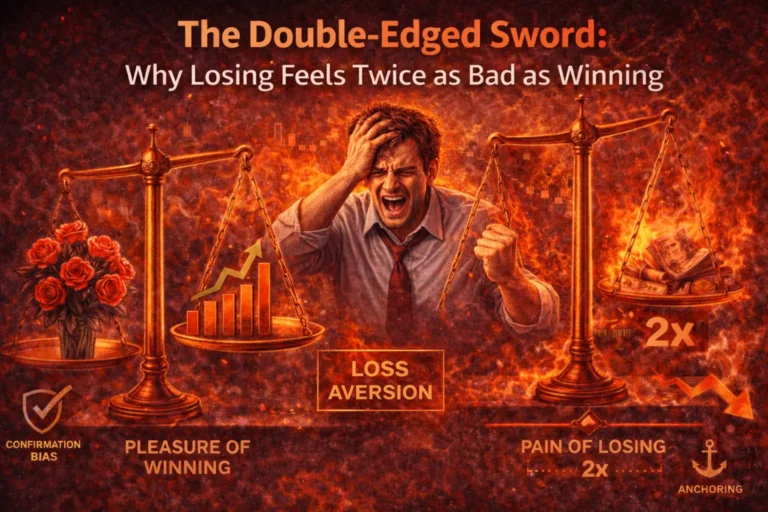
Research shows a consistent pattern: retail investors are desperate to sell their winners to “lock in” the joy of being right, but will hold losers to the bitter end to avoid the pain of being wrong.
Think of it like a garden: we spend all our time pulling the flowers (selling winners) and watering the weeds (holding losers). By the end of the season, your garden is nothing but thorns.
3. The “Break-Even” Mirage (Anchoring Bias)
Why do we obsess over the price we paid? It’s Anchoring Bias. You’ve mentally “anchored” your perception of the stock’s value to your entry point.
When the stock drops, you aren’t evaluating the business; you’re evaluating your bruised ego. You’re ignoring the Opportunity Cost. That capital trapped in a “zombie stock” is a soldier sitting in the barracks while a war is raging elsewhere. If you moved that money into a company with actual growth, you might recover your losses in half the time.
4. The Biological Mismatch: Why Losses Hurt
Evolution didn’t design us for the stock market. Losing money registers in the brain similarly to physical pain.
Realizing a loss is the moment the “threat” becomes “reality.” By holding the stock, you are living in a state of Cognitive Dissonance—you are holding onto the hope that the loss is only “on paper.” But make no mistake: the loss is real, and the potential for recovery is often a fantasy.
5. Building Your “Exit Fortress”
If you want to move from hope-based investing to professional wealth management, use these systems to remove your ego from the equation:
- The Pre-Mortem Thesis: Before you click “Buy,” write down the exact reason you would sell. If the company loses its competitive edge, the thesis is broken—regardless of the price. Selling is no longer a failure; it’s just the execution of a professional plan.
- MandLy Exit Audits: Use your Money Mandal MandLy to conduct an “Exit Audit.” Ask: If I were starting today, would I open a new position in this stock at this price? If the answer is “No,” you are holding out of fear, not strategy.
- The Stop-Loss Discipline: A stop-loss isn’t a suggestion; it’s a circuit breaker. It outsources the painful decision to your “past self,” who was calm and rational.
6. Identifying Your Holding “Archetype”
- The “Wait-and-See”: You stare at the screen waiting for a miracle. (The “Hope” Strategy).
- The “Fundamental Blind”: You read the company’s marketing materials even when the financials are bleeding.
- The “Averager”: You buy more to lower your average price, effectively doubling down on a mistake.
Conclusion: The Art of the “Clean Slate”
The best investors don’t have perfect records; they have clean slates. They are experts at recognizing when a thesis has failed, cutting the cord, and moving on to the next opportunity.
Holding a losing stock is a tax on your mental energy and your financial future. Let the bad trades go. The market is full of new beginnings, but only for those who have the capital to participate.
The “Holding” Reality Check
Before you hold another day, ask:
- The “New Buy” Test: If I didn’t own this today, would I buy it? (If no, sell).
- The Thesis Check: Has the fundamental reason for buying changed?
- The Opportunity Cost Test: Where could this money be working harder right now?
- The “Ego” Test: Am I holding because of the company, or because I don’t want to admit I was wrong?
Why is it so much harder to sell a loser than to sell a winner?
This is the Disposition Effect in action. Biologically, realizing a loss triggers the same areas of the brain as physical pain. By holding on, you keep the loss “on paper,” which allows your brain to maintain the illusion that you haven’t actually lost anything yet. Conversely, selling a winner provides an immediate “dopamine hit” of being right, leading most investors to cut their profits short while letting their losses run.
What is “Anchoring Bias,” and how does it trap my capital?
Anchoring occurs when you fixate on a specific number—usually your original purchase price—as the “true” value of a stock. You stop looking at the company’s actual performance and start waiting for the market to “validate” your entry price. The danger is that the market doesn’t know (or care) what you paid. By anchoring to the past, you ignore the Opportunity Cost: the profit you could be making elsewhere if that money wasn’t trapped in a failing investment.
If I sell now and the stock bounces back, won’t I regret it?
This fear is called Regret Aversion. To counter it, professional traders use a Pre-Mortem Thesis. Before buying, you define the exact conditions under which you will exit (e.g., a 10% drop or a change in CEO). If those conditions are met, selling isn’t a “mistake” even if the stock bounces later—it is a successful execution of your risk management plan. Protecting your capital is always more important than catching a lucky bounce.
How does the “New Buy Test” in the MandLy work?
The New Buy Test is a psychological “reset button.” You ask yourself: “If I didn’t already own this stock, would I buy it at today’s price with fresh cash?” * If the answer is No, you should sell immediately. By choosing to hold, you are effectively “buying” the stock again every single day at the current market price. Using the Money Mandal MandLy to answer this question forces you to face the data rather than your ego.