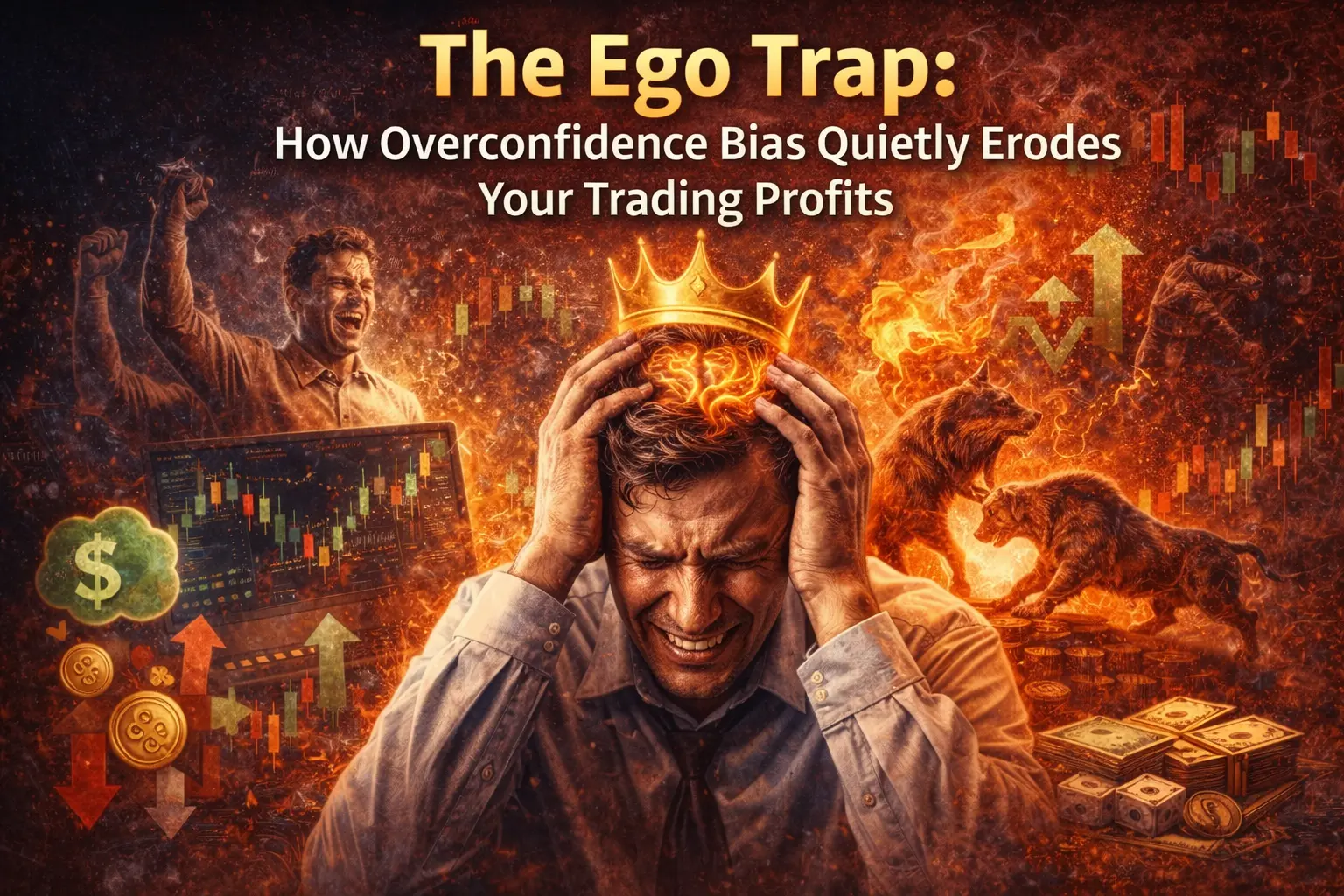
The Ego Trap: How Overconfidence Bias Quietly Erodes Your Trading Profits
In a famous study, 80% of drivers claimed they were “above average.” Mathematically, this is impossible. In the world of trading, that same statistical delusion isn’t just a quirk of human nature, it is a financial death sentence.
We’ve all had “The Week.” You know the one: every trade hits its target, your entries are surgical, and you start wondering why anyone finds trading difficult. You feel invincible. You start eyeing a larger lot size. You stop checking the economic calendar. After all, you’ve “cracked the code.”
Then, the market humbles you. A single trade wipes out the week’s gains because you were too proud to set a stop-loss.
Welcome to Overconfidence Bias. At Money Mandal, we believe that the most dangerous moment in your trading career isn’t when you’re losing—it’s when you’re winning so much that you stop being careful. In this deep dive, we’ll uncover the biological roots of your ego, why winning streaks are the most hazardous phase of a trader’s life, and how to build a “Psychological Fortress” that keeps your feet on the ground.
1. What Exactly Is Overconfidence Bias?
Overconfidence bias is a cognitive distortion where a trader’s subjective confidence in their judgments is reliably greater than the objective accuracy of those judgments.
In simpler terms: You think you know more than you actually do.
This isn’t about having a “can-do” attitude or being optimistic. It is a biological glitch where the brain misinterprets a streak of good luck as a permanent increase in skill. While traditional finance assumes we are rational calculators of probability, behavioral finance shows that our brains are “confidence machines” that often ignore the role of randomness in our success.
When you are overconfident, you don’t see the market as a complex, unpredictable environment; you see it as a puzzle you have solved. This false sense of certainty is the primary reason why even successful traders suddenly blow up their accounts.
2. The Three Faces of Overconfidence
Overconfidence doesn’t always look like arrogance. It usually manifests in three distinct ways, each with its own unique danger to your portfolio:
A. Over-Precision
The belief that you can predict an exact price target or time. You believe your “range” is much narrower than it actually is.
- The Reality: Markets are chaotic systems. Over-precision leads to missing exits or holding for “one more tick” that never comes. You aren’t playing the probabilities; you are playing a game of “pin the tail on the donkey.”
B. Over-Estimation
Thinking you are more skilled than the data suggests. This is often seen in traders who have had a “Lucky Beginner” streak.
- The Reality: They confuse a bull market for their own brilliance. When the market cycle turns, they have no idea how to adjust, because they believe they are “immune” to losses.
C. Over-Placement (The Better-Than-Average Effect)
Believing you have a “special edge” that other retail traders don’t have.
- The Reality: You are competing against high-frequency algorithms and institutional desks with more data and faster execution than you.
3. The Biological High: Why Winning is Dangerous
When you win a trade, your brain releases Dopamine, the “reward” chemical. If you win several trades in a row, your brain enters a state similar to a drug-induced high.
This dopamine flood suppresses the Amygdala,the part of the brain that senses risk. You literally become biologically incapable of seeing danger. This is why traders often follow their best month with their worst month, they are “trading under the influence” of their own success. They move from “The Strategist” (who looks for edge) to “The Gambler” (who looks for the thrill of the win).
4. How Overconfidence Destroys Your Account
How does this psychological bias translate into lost capital? It happens through three specific, predictable behavioral shifts:
1. Excessive Trading (Churning)
Overconfident traders believe every market move is an opportunity they can predict. They trade more frequently, which leads to higher commissions, slippage, and exposure to “noise” rather than high-probability signals. They aren’t trading because the setup is there; they are trading because they feel they must be in the market to prove their status.
2. Under-Diversification and Position Sizing
When you are “sure” about a trade, you are tempted to “go big.” You ignore the 1% risk rule and put 10% or 20% of your account on a single idea. One “Black Swan” event is all it takes to end your career. The overconfident trader views risk management as “fear-based” rather than “survival-based.”
3. Ignoring the “Stop-Loss”
The overconfident trader views a stop-loss as an insult. They believe the market is “wrong” and they are “right.” They move the stop or remove it entirely, turning a small, professional loss into a catastrophic one. They are no longer trading to make money; they are trading to validate their own ego.
5. The “Hindsight Bias” Connection
Overconfidence is fed by its cousin, Hindsight Bias. After a trade works out, we tell ourselves, “I knew that was going to happen.” We forget the uncertainty we felt during the trade. We rewrite our own history to make ourselves look like geniuses.
This “selective memory” prevents us from learning the true lessons of the market and reinforces the delusion that we have a “crystal ball.” If you think you predicted a market move that was actually just a random price fluctuation, you will repeat that mistake in the future with even more conviction.
6. How to Build an “Ego-Buffer” (The Money Mandal Way)
You can’t eliminate your ego, but you can build a system that buffers against it. Here is the professional approach to staying humble:
A. The 5-Trade Rule
No matter how “sure” you are, you must treat every trade as if it has a 50% chance of failing. If you knew the next trade would fail, would you still size it this way? This forces you to respect the math over your “gut.”
B. Track Your “Luck” in MandLy
At Money Mandal, we encourage using the MandLy to track not just the P&L, but the quality of the win.
- Ask yourself: “Did this trade win because I followed my plan, or did I get lucky with a news spike?”
- If you won because of luck, MandLy helps you categorize it as a “Bad Win.” A “Bad Win” is more dangerous than a “Good Loss” because it feeds overconfidence.
C. The “Outside View”
Before taking a large position, intentionally look for the “Bear Case.” Find the smartest person who disagrees with you and read their thesis. If you can’t argue the opposite side of your trade, you are too overconfident to be in it.
7. The Illusion of Control
Many traders suffer from the Illusion of Control—the belief that they can influence outcomes that are fundamentally random. They spend hours researching fundamental data, but they ignore the fact that market psychology, news shocks, and liquidity events can move prices in ways no chart can predict.
The humble trader accepts that they cannot control the market; they can only control their response to it. When you stop trying to force the market to behave according to your predictions, you stop being a victim of your own overconfidence.
8. Identifying the Overconfidence Archetypes
Not all overconfident traders look the same. Which one are you?
- The “News Junkie”: You believe you can predict market reactions to news better than the algorithms can. (Outcome: Over-reaction and losses).
- The “Backtester-Gone-Wild”: You spent weeks backtesting a strategy, and now you believe it will perform perfectly in all market conditions. (Outcome: Failure to adapt to changing volatility).
- The “Prophet”: You think you have a “feel” for the market that doesn’t need to be backed by a trading plan. (Outcome: Inconsistency and eventual account blow-up).
Recognizing which archetype you fall into is the first step toward reclaiming your objectivity.
9. Conclusion: The Market is the Ultimate Teacher
The market has a way of taking money from the arrogant and giving it to the humble. The most successful traders in history—from Paul Tudor Jones to Ray Dalio—all share one trait: Intellectual Humility. They are constantly looking for ways they might be wrong.
Overconfidence feels good in the moment, but it is a silent killer of long-term wealth. True trading mastery isn’t about being “right” all the time; it’s about knowing how to survive when you are “wrong.”
Master your ego, respect the randomness, and let your system do the talking.
The Overconfidence Reality Check
Run this test if you’ve won your last 3 trades in a row:
- Lot Size Check: Am I increasing my size because my account grew, or because I feel “on fire”?
- Research Check: Did I spend as much time on this setup as I did when I was on a losing streak?
- The “What If” Test: If this trade fails and wipes out my last 3 wins, how will that affect my psychology?
- Rule Adherence: Am I skipping any of my entry criteria because “I just know” this one will go?
Is there such a thing as a “Bad Win”?
Absolutely. A Bad Win is a trade where you broke your rules—like skipping a stop-loss or over-leveraging—but you made money anyway due to sheer market luck. These are the most dangerous trades in an investor’s career because they reinforce Overconfidence Bias. They trick your brain into thinking your “gut” is better than your system, setting you up for a catastrophic loss when the luck eventually runs out.
Why does my risk management get worse when I’m on a winning streak?
This is caused by a Dopamine Flood. When you win, your brain releases dopamine, which makes you feel invincible and actually numbs your Amygdala (the part of the brain that detects risk). Biologically, you become “blind” to danger. This is why traders often follow their best month with their worst; they are essentially “trading under the influence” of their own success.
How do I distinguish between “Skill” and “Market Noise”?
The best way to tell the difference is to use a Decision Log. Instead of just tracking profit, track your Process:
Skill: The trade hit your target because you followed every rule in your plan.
Noise/Luck: The trade hit your target because of an unpredictable news spike or a random price swing that happened after you entered for the wrong reasons. If your wins don’t match your strategy, you aren’t skillful; you’re just temporarily lucky.
What is the “Outside View,” and how does it stop my ego?
The Outside View is a technique where you intentionally seek out the “Bear Case” for your “Bull Trade.” Before clicking ‘Buy,’ find the smartest person or most logical data point that says the market will go down. If you can’t argue the opposite side of your trade as well as your own, you are likely suffering from Confirmation Bias fueled by overconfidence.