The Double-Edged Sword: Why Losing Feels Twice as Bad as Winning
If you’ve ever sold a winning stock too early, only to watch it climb another 20%, or held onto a sinking ship of a stock for months hoping it would “just break even,” you haven’t just made a mistake. You have been victimized by your own biology.
Welcome to the most powerful, destructive force in behavioral finance: Loss Aversion.
At Money Mandal, we often say that the market doesn’t care about your feelings—but your brain certainly does. Understanding Loss Aversion is the difference between being a panicked gambler and a disciplined investor.
1. What is Loss Aversion?
In the 1970s, Nobel laureates Daniel Kahneman and Amos Tversky discovered something fascinating about the human mind: We hate losing more than we love winning.
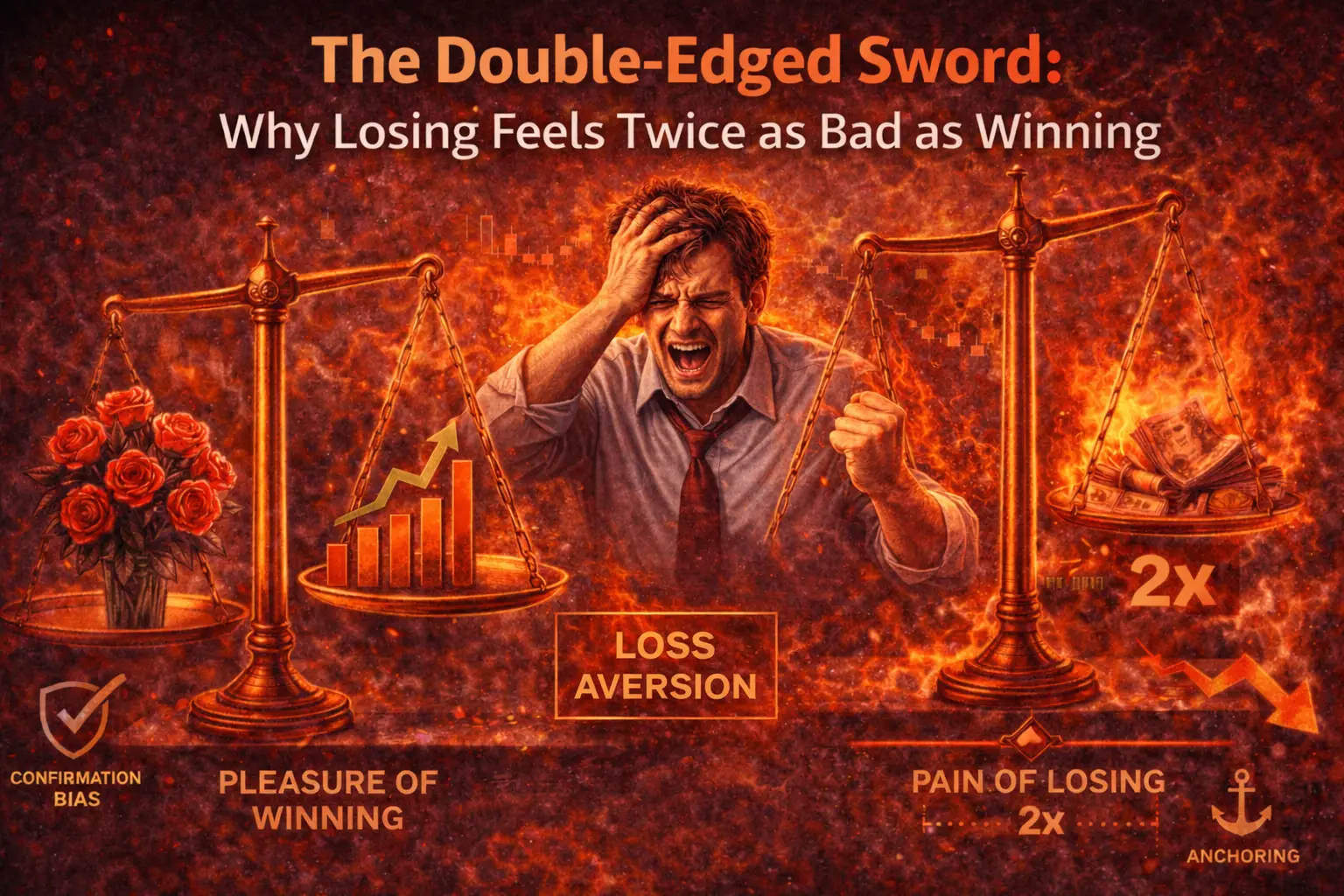
They found that the psychological pain of losing ₹10,000 is about twice as intense as the pleasure of gaining ₹10,000. This is the core of Prospect Theory. Our brains are hardwired for survival, not for the stock market. In the wild, losing your food supply was a life-or-death crisis; finding an extra berry bush was just a nice bonus. Today, that survival mechanism triggers every time you look at your portfolio’s red numbers.
2. Loss Aversion vs. The “Big Three”
To master your mind, you must see how Loss Aversion works alongside other biases. Think of them as a team of saboteurs working against your long-term wealth:
| Bias | The Core Problem | Comparison to Loss Aversion |
| Loss Aversion | Pain of loss > Joy of gain | The “Root” of the emotional response. |
| Anchoring | Fixing on the purchase price | A “Tool” used to justify the pain of loss. |
| Confirmation Bias | Seeking info that validates us | A “Shield” to avoid acknowledging a loss. |
Loss Aversion is the engine, while Anchoring and Confirmation Bias are the steering wheels that drive you off the cliff.
3. The “Break-Even” Trap
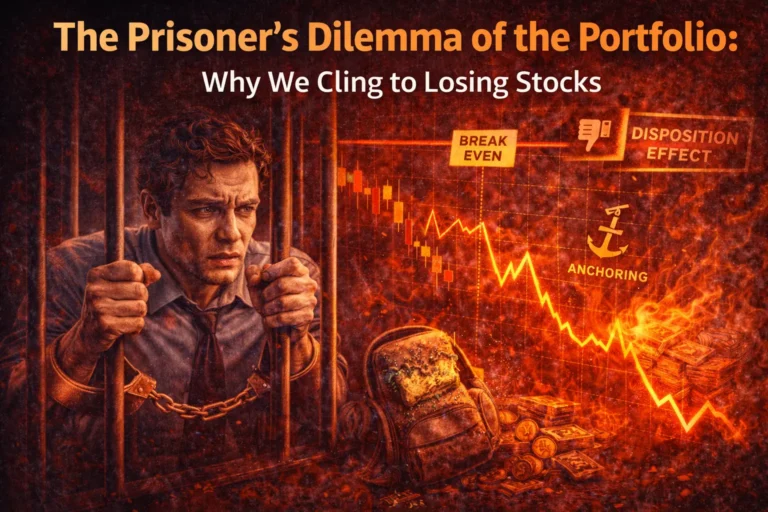
Loss Aversion creates a toxic cycle. When you see a trade go red, your brain enters Cognitive Dissonance. You tell yourself that the loss isn’t “real” as long as you don’t click the “Sell” button.
So, you hold. You aren’t holding because the company is performing well; you’re holding because your brain is trying to protect you from the crushing weight of admitting a mistake.
The Money Mandal Reality Check: If you wouldn’t buy the stock at today’s price, you are effectively buying it every single day you choose to hold it.
4. Why You Sell Winners Too Soon
Loss Aversion also forces you to sell winners too early. Because we are terrified of “losing” the paper gains we’ve made, we rush to secure them. We treat our winning stocks like a fragile glass vase we’re afraid to drop, and our losing stocks like a stubborn stain we’re trying to scrub out. It’s the perfect recipe for mediocrity: you cut your flowers and water your weeds.
5. Hacking Your Biology: The System vs. The Feeling
You cannot “delete” your fear of losing, but you can build a system that prevents it from dictating your trades.
- The Pre-Mortem: Before you enter a trade, write down the exact price where you will sell if you are wrong. By making this decision while you are calm and profitable, you strip the Amygdala of its power.
- The MandLy Audit: Your Money Mandal MandLy is your best weapon. When you feel the urge to sell a winner or hold a loser, record it. Ask: “Am I doing this because the market data changed, or because I’m afraid of how I’ll feel if the price goes down?”
- The “Out of Sight” Strategy: Loss Aversion is triggered by the frequency of feedback. If you aren’t a day trader, stop checking your portfolio every hour. The less you check, the less you feel the “sting.”
6. The Opportunity Cost: The Hidden Tax
Every minute you spend holding a loser out of fear is a minute your capital is dead weight. It isn’t just an emotional tax; it’s an Opportunity Cost. That capital could be working for you in a high-performing asset, but it’s sitting in a graveyard of your past mistakes.
The Loss Aversion Reality Check
Ask these questions before you make a move:
- The “Clean Slate” Test: If I didn’t own this position today, would I open it at the current price? (If no, why am I still holding it?)
- The “Feelings” Filter: Am I holding because of the chart, or because I’m afraid to admit I lost?
- The Math Check: Am I holding to “get back to even,” or because the long-term thesis is still intact?
Conclusion: Mastery is Emotional, Not Mathematical
You don’t need a PhD in Economics to succeed in the market. You just need the courage to admit when you’re wrong and the discipline to let your winners run.
Loss Aversion will always be there, whispering in your ear, trying to get you to “hold on just a little longer.” Learn to recognize that voice for what it is—a biological glitch—and you’ll be one step closer to becoming a true market professional.
Don’t let your biology dictate your bank balance. Master your mind, and the money will follow.
Why does losing money feel so much worse than winning money feels good?
This is the core of Prospect Theory. Evolutionarily, our brains are designed for survival, not wealth. In the wild, losing a day’s worth of food was a life-threatening crisis, while finding extra food was just a “bonus.” As a result, researchers found that the psychological pain of a loss is twice as powerful as the joy of an equivalent gain. This “biological glitch” is what causes investors to panic during dips.
How does Loss Aversion cause me to “cut my flowers and water my weeds”?
Loss Aversion creates a double-edged sword:
The Weeds: You hold onto losing stocks because selling means “realizing” the pain of being wrong. You hope they’ll break even so you can exit without the emotional sting.
The Flowers: You sell winning stocks too quickly because you are terrified of “losing” the profit you’ve already made. This habit leaves your portfolio full of underperformers while your high-growth assets are gone.
What is the “Clean Slate” test, and how does it help?
The Clean Slate test is a mental hack to bypass your emotions. Ask yourself: “If I didn’t own this stock today, and I had the cash in hand, would I buy it at its current price?” * If the answer is No, the only reason you are still holding is Loss Aversion.
If the answer is Yes, your original investment thesis is likely still intact.
Can using the Money Mandal MandLy actually change my biology?
You can’t change your biology, but you can change your behavioral response. When you use the MandLy, you move the decision-making process from the Amygdala (the emotional brain) to the Prefrontal Cortex (the logical brain). By writing down why you are making a trade before you execute it, you create a “logical circuit breaker” that prevents a temporary emotional sting from becoming a permanent financial mistake.